
Model predictive control (MPC) is the algorithm that separates a truly intelligent heating system from a smart-looking one. While most "smart" thermostats still react to temperature changes after they happen, MPC looks forward — building a prediction of future conditions and calculating the optimal heating strategy before those conditions arrive.
It is the control method at the core of Fourdeg's heating optimization, and understanding how it works explains why buildings with MPC consistently outperform those with conventional control.
What is Model Predictive Control?
Model predictive control is an advanced control strategy originally developed for industrial processes — chemical plants, refineries, and aerospace systems — that require precise, coordinated control of multiple variables simultaneously. It was adapted for building energy management in the 2000s, and the falling cost of sensors and cloud computing has made it practical at the scale of individual buildings and homes.
The defining feature of MPC is the rolling horizon: at each control step (typically every 15–60 minutes), the controller solves an optimization problem over the next 12–48 hours, determines the optimal sequence of heating actions, applies the first action, then repeats the calculation at the next step with updated measurements. This means the controller is always working with the most current data and always planning ahead — never just reacting.
The "model" in MPC is a mathematical representation of the building's thermal behaviour: how indoor temperatures respond to changes in heating output, outdoor temperature, sunlight, and occupancy. This model is what allows the controller to make reliable predictions rather than guesses.
How MPC Works in Fourdeg
Fourdeg's implementation of MPC operates on three interconnected layers:
1. The Building Thermal Model
When Fourdeg smart thermostats are installed, the system begins observing real temperature data in each room and correlating it with outdoor conditions, solar radiation, and heating inputs. Over the first weeks of operation, it builds a parametric thermal model for each room — capturing thermal resistance (insulation quality), thermal capacitance (how much heat the structure stores), and the influence of solar gain.
This model is continuously updated as the system gathers more data, becoming more accurate over time. Buildings with unusual construction, recent renovations, or seasonal occupancy patterns are accommodated automatically — the model simply learns from what it observes.
2. Weather Forecast Integration
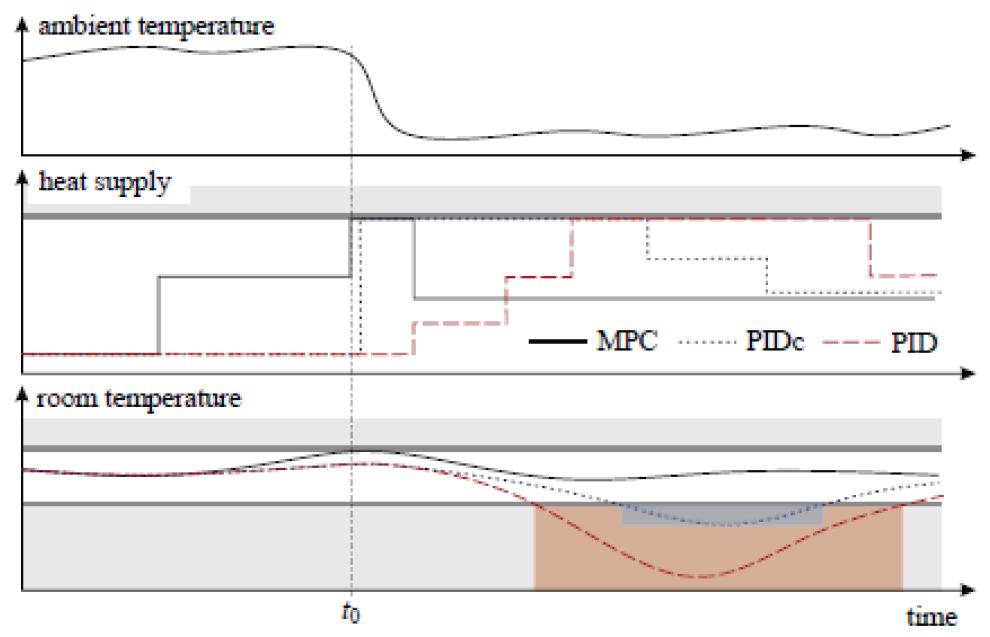
Using a 48-hour weather forecast — outdoor temperature, cloud cover, solar radiation, and wind — the MPC controller projects what each room's temperature will be under different heating scenarios. This is where the real value of prediction emerges:
- If outdoor temperature will drop sharply overnight, the system pre-heats the building in the evening when energy may be cheaper
- If a sunny morning is forecast, south-facing rooms are not pre-heated — the sun will do the work for free
- If a cold week follows a mild weekend, the building's thermal mass is pre-charged strategically
3. The Optimization Calculation
Every control step, the MPC algorithm solves a constrained optimization problem: given the current state of the building, the weather forecast, and the thermal model — what heating actions over the next 24 hours will keep all rooms within their comfort temperature limits while minimizing energy consumption (and cost)?
The constraints include minimum and maximum room temperatures (the comfort limits set by the occupants), maximum heating power (limited by the radiator capacity), and where applicable, energy price signals that make it cheaper to heat during certain hours. The optimizer balances all of these simultaneously, room by room, across the entire building.
Why MPC Outperforms Conventional Control
A conventional thermostat has no model of the building, no forecast, and no optimization horizon. It simply measures current temperature and compares it to a setpoint. This leads to several systematic inefficiencies:
- Overheating: When outdoor temperatures rise unexpectedly or sunlight enters a room, conventional control continues heating until the thermostat trips — wasting energy and creating discomfort
- Cold morning lag: Conventional systems wake up at a set time and start heating, but they cannot know how long it will take to warm the building on a particular morning. MPC calculates this in advance
- Energy cost blindness: Fixed schedules heat at programmed times regardless of whether energy is cheap or expensive. MPC can shift consumption to cheaper periods automatically
- No thermal mass exploitation: Buildings can store significant heat in their structure. Conventional control ignores this; MPC uses it as a free resource
The result is that MPC-controlled buildings consistently use 20–35% less energy than conventionally controlled ones while simultaneously providing more stable indoor temperatures.
MPC and Demand-Side Response
MPC is also the enabling technology for demand-side response (DSR) in district heating. When an energy company wants to reduce peak load across its network, it sends a demand reduction signal to Fourdeg's platform. The MPC controller in each connected building evaluates how much demand reduction is possible — given current temperatures, the weather forecast, and each building's thermal model — and calculates the safest pre-heating strategy that maximizes flexibility while protecting indoor comfort.
This is why room-level control and building-specific thermal models are essential for real DSR: without knowing exactly how much thermal buffer each building has, you cannot safely commit to demand flexibility. With MPC, the commitment is backed by physics, not guesswork.
What Data Does MPC Use?
- Building thermal model: Learned from historical temperature data — resistance, capacitance, and solar gain coefficients for each room
- Real-time room temperatures: Measured by each radiator thermostat every few minutes
- Weather forecasts: Outdoor temperature, solar radiation, cloud cover, and wind speed — typically 48-hour horizon
- District heating supply temperature: The heat available from the network at any given time
- Energy pricing signals: Where available, time-of-use prices that reward shifting consumption to off-peak periods
"Model Predictive Control turns heating from a reactive process into a proactive, intelligent system. It doesn't wait for the room to get cold — it calculates hours in advance exactly how and when to heat, then does it automatically."
Frequently Asked Questions
What is model predictive control (MPC)?
MPC is an advanced control algorithm that uses a mathematical model of a system to predict its future behaviour and optimize control actions over a rolling time horizon. In heating, the model represents how a building absorbs and releases heat. The controller continuously predicts future indoor temperatures based on weather forecasts and building dynamics, then calculates the optimal heating schedule that keeps temperatures within comfort limits at minimum energy cost.
How does MPC differ from a standard thermostat?
A standard thermostat is reactive — it turns heating on when temperature falls below a setpoint and off when it rises above. MPC is proactive: it looks 12–24 hours ahead and calculates the heating schedule that will maintain comfort over that entire horizon. MPC can pre-heat before a cold front, reduce output before a sunny morning, and shift consumption to cheaper tariff periods — all automatically.
How much energy does model predictive control save?
Buildings using Fourdeg's MPC-based control consistently achieve 20–35% energy savings compared to conventional thermostat control. The savings come from eliminating overheating, pre-heating during cheap energy windows, and reducing standby losses. Buildings with significant solar gain or high occupancy variation tend to see the largest improvements.
What is a thermal model of a building?
A thermal model is a mathematical representation of how a building absorbs, stores, and loses heat — capturing insulation quality, structural heat storage capacity, and the relationship between outdoor conditions and indoor temperature. Fourdeg's system builds this model automatically by observing real temperature data over the first weeks of operation. No manual surveys required.